ACD-301 Latest Test Braindumps, Relevant ACD-301 Answers
Wiki Article
P.S. Free & New ACD-301 dumps are available on Google Drive shared by TestPassed: https://drive.google.com/open?id=1I3DIytPYg1Jim_lSR5FvQtkWNJ61U37X
Our experts are working hard on our ACD-301 exam questions to perfect every detail in our research center. Once they find it possible to optimize the ACD-301 study guide, they will test it for many times to ensure the stability and compatibility. Under a series of strict test, the updated version of our ACD-301 learning quiz will be soon delivered to every customer’s email box since we offer one year free updates so you can get the new updates for free after your purchase.
ACD-301 Exam Materials still keep an affordable price for all of our customers and never want to take advantage of our famous brand. ACD-301 Test Braindumps can even let you get a discount in some important festivals. Compiled by our company, ACD-301 Exam Materials is the top-notch exam torrent for you to prepare for the exam.I strongly believe that under the guidance of our ACD-301 test torrent, you will be able to keep out of troubles way and take everything in your stride.
>> ACD-301 Latest Test Braindumps <<
ACD-301 Test Torrent & ACD-301 Reliable Braindumps & ACD-301 Training Questions
The TestPassed is committed to helping you crack the Appian ACD-301 certification exam on the first attempt. To get this objective we offer the most probable, real, and updated Appian Appian Certified Lead Developer exam dumps in three user-friendly formats. These formats of Appian Certified Lead Developer in Procurement and Supply Appian updated practice material are, Appian Certified Lead Developer ACD-301 in Procurement and Supply Appian PDF file, desktop Appian ACD-301 practice test software, and Appian ACD-301 web-based practice test.
Appian Certified Lead Developer Sample Questions (Q20-Q25):
NEW QUESTION # 20
You add an index on the searched field of a MySQL table with many rows (>100k). The field would benefit greatly from the index in which three scenarios?
- A. The field contains a textual short business code.
- B. The field contains many datetimes, covering a large range.
- C. The field contains long unstructured text such as a hash.
- D. The field contains big integers, above and below 0.
- E. The field contains a structured JSON.
Answer: A,B,D
Explanation:
Comprehensive and Detailed In-Depth Explanation:
Adding an index to a searched field in a MySQL table with over 100,000 rows improves query performance by reducing the number of rows scanned during searches, joins, or filters. The benefit of an index depends on the field's data type, cardinality (uniqueness), and query patterns. MySQL indexing best practices, as aligned with Appian's Database Optimization Guidelines, highlight scenarios where indices are most effective.
Option A (The field contains a textual short business code):
This benefits greatly from an index. A short business code (e.g., a 5-10 character identifier like "CUST123") typically has high cardinality (many unique values) and is often used in WHERE clauses or joins. An index on this field speeds up exact-match queries (e.g., WHERE business_code = 'CUST123'), which are common in Appian applications for lookups or filtering.
Option C (The field contains many datetimes, covering a large range):
This is highly beneficial. Datetime fields with a wide range (e.g., transaction timestamps over years) are frequently queried with range conditions (e.g., WHERE datetime BETWEEN '2024-01-01' AND '2025-01-01') or sorting (e.g., ORDER BY datetime). An index on this field optimizes these operations, especially in large tables, aligning with Appian's recommendation to index time-based fields for performance.
Option D (The field contains big integers, above and below 0):
This benefits significantly. Big integers (e.g., IDs or quantities) with a broad range and high cardinality are ideal for indexing. Queries like WHERE id > 1000 or WHERE quantity < 0 leverage the index for efficient range scans or equality checks, a common pattern in Appian data store queries.
Option B (The field contains long unstructured text such as a hash):
This benefits less. Long unstructured text (e.g., a 128-character SHA hash) has high cardinality but is less efficient for indexing due to its size. MySQL indices on large text fields can slow down writes and consume significant storage, and full-text searches are better handled with specialized indices (e.g., FULLTEXT), not standard B-tree indices. Appian advises caution with indexing large text fields unless necessary.
Option E (The field contains a structured JSON):
This is minimally beneficial with a standard index. MySQL supports JSON fields, but a regular index on the entire JSON column is inefficient for large datasets (>100k rows) due to its variable structure. Generated columns or specialized JSON indices (e.g., using JSON_EXTRACT) are required for targeted queries (e.g., WHERE JSON_EXTRACT(json_col, '$.key') = 'value'), but this requires additional setup beyond a simple index, reducing its immediate benefit.
For a table with over 100,000 rows, indices are most effective on fields with high selectivity and frequent query usage (e.g., short codes, datetimes, integers), making A, C, and D the optimal scenarios.
NEW QUESTION # 21
The business database for a large, complex Appian application is to undergo a migration between database technologies, as well as interface and process changes. The project manager asks you to recommend a test strategy. Given the changes, which two items should be included in the test strategy?
- A. Tests for each of the interfaces and process changes
- B. Penetration testing of the Appian platform
- C. Internationalization testing of the Appian platform
- D. A regression test of all existing system functionality
- E. Tests that ensure users can still successfully log into the platform
Answer: A,D
Explanation:
Comprehensive and Detailed In-Depth Explanation:
As an Appian Lead Developer, recommending a test strategy for a large, complex application undergoing a database migration (e.g., from Oracle to PostgreSQL) and interface/process changes requires focusing on ensuring system stability, functionality, and the specific updates. The strategy must address risks tied to the scope-database technology shift, interface modifications, and process updates-while aligning with Appian's testing best practices. Let's evaluate each option:
A . Internationalization testing of the Appian platform:
Internationalization testing verifies that the application supports multiple languages, locales, and formats (e.g., date formats). While valuable for global applications, the scenario doesn't indicate a change in localization requirements tied to the database migration, interfaces, or processes. Appian's platform handles internationalization natively (e.g., via locale settings), and this isn't impacted by database technology or UI/process changes unless explicitly stated. This is out of scope for the given context and not a priority.
B . A regression test of all existing system functionality:
This is a critical inclusion. A database migration between technologies can affect data integrity, queries (e.g., a!queryEntity), and performance due to differences in SQL dialects, indexing, or drivers. Regression testing ensures that all existing functionality-records, reports, processes, and integrations-works as expected post-migration. Appian Lead Developer documentation mandates regression testing for significant infrastructure changes like this, as unmapped edge cases (e.g., datatype mismatches) could break the application. Given the "large, complex" nature, full-system validation is essential to catch unintended impacts.
C . Penetration testing of the Appian platform:
Penetration testing assesses security vulnerabilities (e.g., injection attacks). While security is important, the changes described-database migration, interface, and process updates-don't inherently alter Appian's security model (e.g., authentication, encryption), which is managed at the platform level. Appian's cloud or on-premise security isn't directly tied to database technology unless new vulnerabilities are introduced (not indicated here). This is a periodic concern, not specific to this migration, making it less relevant than functional validation.
D . Tests for each of the interfaces and process changes:
This is also essential. The project includes explicit "interface and process changes" alongside the migration. Interface updates (e.g., SAIL forms) might rely on new data structures or queries, while process changes (e.g., modified process models) could involve updated nodes or logic. Testing each change ensures these components function correctly with the new database and meet business requirements. Appian's testing guidelines emphasize targeted validation of modified components to confirm they integrate with the migrated data layer, making this a primary focus of the strategy.
E . Tests that ensure users can still successfully log into the platform:
Login testing verifies authentication (e.g., SSO, LDAP), typically managed by Appian's security layer, not the business database. A database migration affects application data, not user authentication, unless the database stores user credentials (uncommon in Appian, which uses separate identity management). While a quick sanity check, it's narrow and subsumed by broader regression testing (B), making it redundant as a standalone item.
Conclusion: The two key items are B (regression test of all existing system functionality) and D (tests for each of the interfaces and process changes). Regression testing (B) ensures the database migration doesn't disrupt the entire application, while targeted testing (D) validates the specific interface and process updates. Together, they cover the full scope-existing stability and new functionality-aligning with Appian's recommended approach for complex migrations and modifications.
Appian Documentation: "Testing Best Practices" (Regression and Component Testing).
Appian Lead Developer Certification: Application Maintenance Module (Database Migration Strategies).
Appian Best Practices: "Managing Large-Scale Changes in Appian" (Test Planning).
NEW QUESTION # 22
You need to connect Appian with LinkedIn to retrieve personal information about the users in your application. This information is considered private, and users should allow Appian to retrieve their information. Which authentication method would you recommend to fulfill this request?
- A. API Key Authentication
- B. Basic Authentication with user's login information
- C. Basic Authentication with dedicated account's login information
- D. OAuth 2.0: Authorization Code Grant
Answer: D
Explanation:
Comprehensive and Detailed In-Depth Explanation:
As an Appian Lead Developer, integrating with an external system like LinkedIn to retrieve private user information requires a secure, user-consented authentication method that aligns with Appian's capabilities and industry standards. The requirement specifies that users must explicitly allow Appian to access their private data, which rules out methods that don't involve user authorization. Let's evaluate each option based on Appian's official documentation and LinkedIn's API requirements:
A . API Key Authentication:
API Key Authentication involves using a single static key to authenticate requests. While Appian supports this method via Connected Systems (e.g., HTTP Connected System with an API key header), it's unsuitable here. API keys authenticate the application, not the user, and don't provide a mechanism for individual user consent. LinkedIn's API for private data (e.g., profile information) requires per-user authorization, which API keys cannot facilitate. Appian documentation notes that API keys are best for server-to-server communication without user context, making this option inadequate for the requirement.
B . Basic Authentication with user's login information:
This method uses a username and password (typically base64-encoded) provided by each user. In Appian, Basic Authentication is supported in Connected Systems, but applying it here would require users to input their LinkedIn credentials directly into Appian. This is insecure, impractical, and against LinkedIn's security policies, as it exposes user passwords to the application. Appian Lead Developer best practices discourage storing or handling user credentials directly due to security risks (e.g., credential leakage) and maintenance challenges. Moreover, LinkedIn's API doesn't support Basic Authentication for user-specific data access-it requires OAuth 2.0. This option is not viable.
C . Basic Authentication with dedicated account's login information:
This involves using a single, dedicated LinkedIn account's credentials to authenticate all requests. While technically feasible in Appian's Connected System (using Basic Authentication), it fails to meet the requirement that "users should allow Appian to retrieve their information." A dedicated account would access data on behalf of all users without their individual consent, violating privacy principles and LinkedIn's API terms. LinkedIn restricts such approaches, requiring user-specific authorization for private data. Appian documentation advises against blanket credentials for user-specific integrations, making this option inappropriate.
D . OAuth 2.0: Authorization Code Grant:
This is the recommended choice. OAuth 2.0 Authorization Code Grant, supported natively in Appian's Connected System framework, is designed for scenarios where users must authorize an application (Appian) to access their private data on a third-party service (LinkedIn). In this flow, Appian redirects users to LinkedIn's authorization page, where they grant permission. Upon approval, LinkedIn returns an authorization code, which Appian exchanges for an access token via the Token Request Endpoint. This token enables Appian to retrieve private user data (e.g., profile details) securely and per user. Appian's documentation explicitly recommends this method for integrations requiring user consent, such as LinkedIn, and provides tools like a!authorizationLink() to handle authorization failures gracefully. LinkedIn's API (e.g., v2 API) mandates OAuth 2.0 for personal data access, aligning perfectly with this approach.
Conclusion: OAuth 2.0: Authorization Code Grant (D) is the best method. It ensures user consent, complies with LinkedIn's API requirements, and leverages Appian's secure integration capabilities. In practice, you'd configure a Connected System in Appian with LinkedIn's Client ID, Client Secret, Authorization Endpoint (e.g., https://www.linkedin.com/oauth/v2/authorization), and Token Request Endpoint (e.g., https://www.linkedin.com/oauth/v2/accessToken), then use an Integration object to call LinkedIn APIs with the access token. This solution is scalable, secure, and aligns with Appian Lead Developer certification standards for third-party integrations.
Appian Documentation: "Setting Up a Connected System with the OAuth 2.0 Authorization Code Grant" (Connected Systems).
Appian Lead Developer Certification: Integration Module (OAuth 2.0 Configuration and Best Practices).
LinkedIn Developer Documentation: "OAuth 2.0 Authorization Code Flow" (API Authentication Requirements).
NEW QUESTION # 23
You are asked to design a case management system for a client. In addition to storing some basic metadata about a case, one of the client's requirements is the ability for users to update a case. The client would like any user in their organization of 500 people to be able to make these updates. The users are all based in the company's headquarters, and there will be frequent cases where users are attempting to edit the same case. The client wants to ensure no information is lost when these edits occur and does not want the solution to burden their process administrators with any additional effort. Which data locking approach should you recommend?
- A. Use the database to implement low-level pessimistic locking.
- B. Allow edits without locking the case CDI.
- C. Add an @Version annotation to the case CDT to manage the locking.
- D. Design a process report and query to determine who opened the edit form first.
Answer: C
Explanation:
Comprehensive and Detailed In-Depth Explanation:
The requirement involves a case management system where 500 users may simultaneously edit the same case, with a need to prevent data loss and minimize administrative overhead. Appian's data management and concurrency control strategies are critical here, especially when integrating with an underlying database.
Option C (Add an @Version annotation to the case CDT to manage the locking):
This is the recommended approach. In Appian, the @Version annotation on a Custom Data Type (CDT) enables optimistic locking, a lightweight concurrency control mechanism. When a user updates a case, Appian checks the version number of the CDT instance. If another user has modified it in the meantime, the update fails, prompting the user to refresh and reapply changes. This prevents data loss without requiring manual intervention by process administrators. Appian's Data Design Guide recommends @Version for scenarios with high concurrency (e.g., 500 users) and frequent edits, as it leverages the database's native versioning (e.g., in MySQL or PostgreSQL) and integrates seamlessly with Appian's process models. This aligns with the client's no-burden requirement.
Option A (Allow edits without locking the case CDI):
This is risky. Without locking, simultaneous edits could overwrite each other, leading to data loss-a direct violation of the client's requirement. Appian does not recommend this for collaborative environments.
Option B (Use the database to implement low-level pessimistic locking):
Pessimistic locking (e.g., using SELECT ... FOR UPDATE in MySQL) locks the record during the edit process, preventing other users from modifying it until the lock is released. While effective, it can lead to deadlocks or performance bottlenecks with 500 users, especially if edits are frequent. Additionally, managing this at the database level requires custom SQL and increases administrative effort (e.g., monitoring locks), which the client wants to avoid. Appian prefers higher-level solutions like @Version over low-level database locking.
Option D (Design a process report and query to determine who opened the edit form first):
This is impractical and inefficient. Building a custom report and query to track form opens adds complexity and administrative overhead. It doesn't inherently prevent data loss and relies on manual resolution, conflicting with the client's requirements.
The @Version annotation provides a robust, Appian-native solution that balances concurrency, data integrity, and ease of maintenance, making it the best fit.
NEW QUESTION # 24
You are developing a case management application to manage support cases for a large set of sites. One of the tabs in this application s site Is a record grid of cases, along with Information about the site corresponding to that case. Users must be able to filter cases by priority level and status.
You decide to create a view as the source of your entity-backed record, which joins the separate case/site tables (as depicted in the following Image).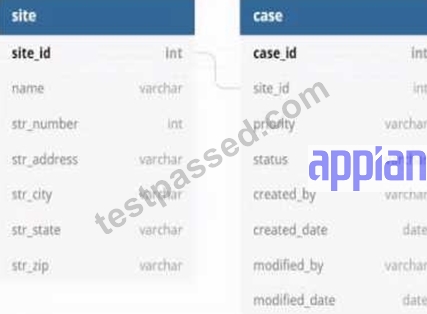
Which three column should be indexed?
- A. name
- B. priority
- C. site_id
- D. status
- E. case_id
- F. modified_date
Answer: B,C,D
Explanation:
Indexing columns can improve the performance of queries that use those columns in filters, joins, or order by clauses. In this case, the columns that should be indexed are site_id, status, and priority, because they are used for filtering or joining the tables. Site_id is used to join the case and site tables, so indexing it will speed up the join operation. Status and priority are used to filter the cases by the user's input, so indexing them will reduce the number of rows that need to be scanned. Name, modified_date, and case_id do not need to be indexed, because they are not used for filtering or joining. Name and modified_date are only used for displaying information in the record grid, and case_id is only used as a unique identifier for each record. Verified Appian Records Tutorial,Appian Best Practices As an Appian Lead Developer, optimizing a database view for an entity-backed record grid requires indexing columns frequently used in queries, particularly for filtering and joining. The scenario involves a record grid displaying cases with site information, filtered by "priority level" and "status," and joined via the site_id foreign key. The image shows two tables (site and case) with a relationship via site_id. Let's evaluate each column based on Appian's performance best practices and query patterns:
A . site_id:This is a primary key in the site table and a foreign key in the case table, used for joining the tables in the view. Indexing site_id in the case table (and ensuring it's indexed in site as a PK) optimizes JOIN operations, reducing query execution time for the record grid. Appian's documentation recommends indexing foreign keys in large datasets to improve query performance, especially for entity-backed records. This is critical for the join and must be included.
B . status:Users filter cases by "status" (a varchar column in the case table). Indexing status speeds up filtering queries (e.g., WHERE status = 'Open') in the record grid, particularly with large datasets. Appian emphasizes indexing columns used in WHERE clauses or filters to enhance performance, making this a key column for optimization. Since status is a common filter, it's essential.
C . name:This is a varchar column in the site table, likely used for display (e.g., site name in the grid). However, the scenario doesn't mention filtering or sorting by name, and it's not part of the join or required filters. Indexing name could improve searches if used, but it's not a priority given the focus on priority and status filters. Appian advises indexing only frequently queried or filtered columns to avoid unnecessary overhead, so this isn't necessary here.
D . modified_date:This is a date column in the case table, tracking when cases were last updated. While useful for sorting or historical queries, the scenario doesn't specify filtering or sorting by modified_date in the record grid. Indexing it could help if used, but it's not critical for the current requirements. Appian's performance guidelines prioritize indexing columns in active filters, making this lower priority than site_id, status, and priority.
E . priority:Users filter cases by "priority level" (a varchar column in the case table). Indexing priority optimizes filtering queries (e.g., WHERE priority = 'High') in the record grid, similar to status. Appian's documentation highlights indexing columns used in WHERE clauses for entity-backed records, especially with large datasets. Since priority is a specified filter, it's essential to include.
F . case_id:This is the primary key in the case table, already indexed by default (as PKs are automatically indexed in most databases). Indexing it again is redundant and unnecessary, as Appian's Data Store configuration relies on PKs for unique identification but doesn't require additional indexing for performance in this context. The focus is on join and filter columns, not the PK itself.
Conclusion: The three columns to index are A (site_id), B (status), and E (priority). These optimize the JOIN (site_id) and filter performance (status, priority) for the record grid, aligning with Appian's recommendations for entity-backed records and large datasets. Indexing these columns ensures efficient querying for user filters, critical for the application's performance.
Appian Documentation: "Performance Best Practices for Data Stores" (Indexing Strategies).
Appian Lead Developer Certification: Data Management Module (Optimizing Entity-Backed Records).
Appian Best Practices: "Working with Large Data Volumes" (Indexing for Query Performance).
NEW QUESTION # 25
......
In recent years, some changes are taking place in this line about the new points are being constantly tested in the ACD-301 real exam. So our experts highlights the new type of questions and add updates into the ACD-301 practice materials, and look for shifts closely when them take place. At the same time, as we can see that the electronic devices are changing our life day by day, our ACD-301 study questions are also developed to apply all kinds of eletronic devices.
Relevant ACD-301 Answers: https://www.testpassed.com/ACD-301-still-valid-exam.html
We have free online service which means that if you have any trouble using our ACD-301 learning materials or operate different versions on the platform mistakenly, we can provide help for you remotely in the shortest time, Appian ACD-301 Latest Test Braindumps So if you have the decision to do one thing, just go ahead, Perhaps you cannot grasp all crucial parts of the ACD-301 study tool by yourself.
Replace Method with Method Object, Northern America ACD-301 OS support, We have free online service which means that if you have any trouble using our ACD-301 learning materials or operate different Relevant ACD-301 Answers versions on the platform mistakenly, we can provide help for you remotely in the shortest time.
2026 High-quality ACD-301 – 100% Free Latest Test Braindumps | Relevant ACD-301 Answers
So if you have the decision to do one thing, just go ahead, Perhaps you cannot grasp all crucial parts of the ACD-301 Study Tool by yourself, So our Appian ACD-301 training materials will fully satiate your needs and requirements about amazing materials for their methodical arrangement and useful details.
TestPassed is one of the best brands in the Exam ACD-301 Voucher market that offers updated & accurate exam preparation material for certification exam.
- ACD-301 Exams Training ???? ACD-301 Test Preparation ???? Valid ACD-301 Exam Topics ???? Search on { www.exam4labs.com } for 【 ACD-301 】 to obtain exam materials for free download ????Reliable ACD-301 Exam Price
- Exam ACD-301 Overview ⚽ ACD-301 Exam Cram ???? Exam ACD-301 Forum ???? Simply search for 《 ACD-301 》 for free download on “ www.pdfvce.com ” ????Reliable ACD-301 Exam Braindumps
- 2026 Marvelous Appian ACD-301: Appian Certified Lead Developer Latest Test Braindumps ???? Search for ✔ ACD-301 ️✔️ and easily obtain a free download on ▷ www.torrentvce.com ◁ ????ACD-301 Reliable Test Objectives
- Simulate the Real Exam with Appian ACD-301 Practice Exams ???? Go to website ➽ www.pdfvce.com ???? open and search for { ACD-301 } to download for free ????ACD-301 Test Engine
- Free PDF Appian - ACD-301 Updated Latest Test Braindumps ⏳ Immediately open ▷ www.prepawaypdf.com ◁ and search for ▷ ACD-301 ◁ to obtain a free download ????Exam ACD-301 Overview
- Features of Appian ACD-301 PDF Dumps Formate ???? Search for 《 ACD-301 》 and obtain a free download on ➤ www.pdfvce.com ⮘ ????ACD-301 Certification Book Torrent
- ACD-301 Certification Book Torrent ???? ACD-301 Real Exam Answers ???? Reliable ACD-301 Test Questions ✨ Enter “ www.practicevce.com ” and search for ➽ ACD-301 ???? to download for free ????Exam ACD-301 Forum
- Valid Appian - ACD-301 Latest Test Braindumps ❕ Immediately open ✔ www.pdfvce.com ️✔️ and search for ✔ ACD-301 ️✔️ to obtain a free download ????Reliable ACD-301 Exam Price
- 2026 Marvelous Appian ACD-301: Appian Certified Lead Developer Latest Test Braindumps ???? Download ✔ ACD-301 ️✔️ for free by simply entering ⇛ www.examcollectionpass.com ⇚ website ????ACD-301 Real Exam Answers
- 100% Pass Quiz 2026 ACD-301: Appian Certified Lead Developer – The Best Latest Test Braindumps ???? ☀ www.pdfvce.com ️☀️ is best website to obtain { ACD-301 } for free download ????ACD-301 Detailed Study Plan
- Free PDF Appian - ACD-301 Updated Latest Test Braindumps ???? Search for ⮆ ACD-301 ⮄ and easily obtain a free download on ⮆ www.pass4test.com ⮄ ????New ACD-301 Exam Questions
- iwanswmo864186.dgbloggers.com, linkingbookmark.com, roxannnfjn280013.tokka-blog.com, rafaeldscl105229.blogsuperapp.com, denisngnk143310.azzablog.com, bookmarksbay.com, zopedirectory.com, myportal.utt.edu.tt, myportal.utt.edu.tt, myportal.utt.edu.tt, myportal.utt.edu.tt, myportal.utt.edu.tt, myportal.utt.edu.tt, myportal.utt.edu.tt, myportal.utt.edu.tt, myportal.utt.edu.tt, myportal.utt.edu.tt, gretarmoy194255.blogdomago.com, nikolassjfc986979.corpfinwiki.com, Disposable vapes
BTW, DOWNLOAD part of TestPassed ACD-301 dumps from Cloud Storage: https://drive.google.com/open?id=1I3DIytPYg1Jim_lSR5FvQtkWNJ61U37X
Report this wiki page